From Hand-Set Type to the Composing Stick
See how the composing stick gathered loose metal letters into measured lines, and why its adjustable bed shaped the rhythm of hand composition.
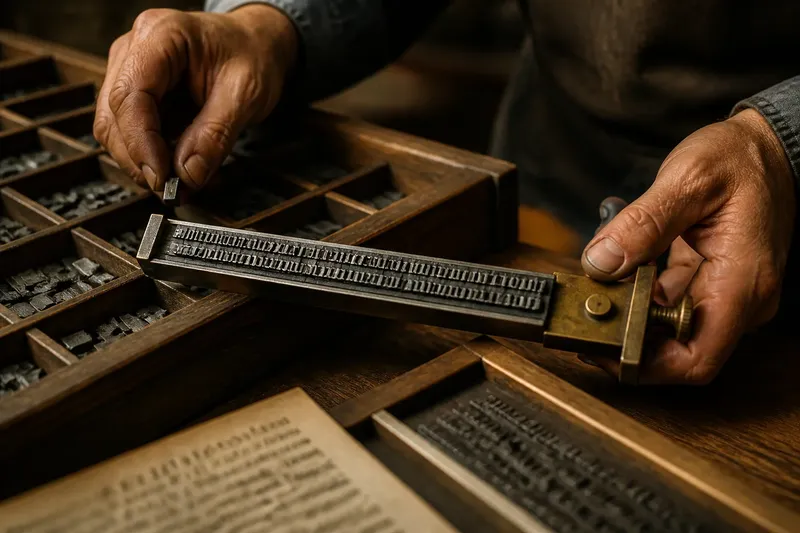
A printer lifts a composing stick from the case, slides its adjustable end to the chosen measure, then reaches for a lower-case e. A composing stick gave each loose piece of type a temporary, carefully measured home before the page took shape.
It was not a miniature printing press, nor a device that arranged a whole page by itself. Its importance lay in a modest task performed repeatedly: holding a line of individual sorts at a width the compositor had selected, while leaving the line flexible enough to justify and transfer.
What problem did the composing stick solve?
Before type could be inked and printed, a compositor had to assemble separate metal sorts—each carrying a letter, space, or mark—into words and lines. A type case kept these pieces sorted for retrieval, but it did not hold a sentence together. Without a portable holder, the compositor would have had to support a growing line by hand or work directly in a larger frame.
The composing stick supplied a narrow channel for the work. Its bed supported the type; side walls kept the sorts aligned; and a movable end set the line’s working measure. The tool let the compositor build one line, adjust it, then begin another without losing the arrangement already made.
That distinction mattered. A line was not simply a row of characters that happened to fit. It was a unit being composed to a chosen width, with spaces between words serving as adjustable elements. The stick made that width tangible: the compositor could feel when the line approached its limit and make a decision before the type spilled past the end.
How was the measure set?
Composing sticks came in different forms, but the familiar hand tool had a flat bed, a fixed side and an adjustable end piece. A screw or other fastening held the end in place. Moving it altered the available length, giving the compositor a repeatable measure for the lines being set.
Measure might be expressed in picas or another printer’s unit, depending on the shop’s equipment and practice. The practical point was consistency within the job: a chosen measure helped lines align in the column or page area for which they were intended. The stick did not decide that measure. The compositor selected it in relation to the job’s page plan and type.
Once the end was secured, the compositor picked sorts from the case and placed them in the channel, often working from left to right while the type itself was held in the orientation needed for printing. The letters sat upside down and reversed from the reader’s perspective. Familiarity with the case and the type’s arrangement made quick retrieval possible, but the stick’s walls still did essential work: they kept the growing line together as each piece was added.
How did loose letters become a finished line?
Words entered the stick as sequences of sorts, separated by spaces. A compositor did not usually treat those spaces as fixed punctuation between words. Their width could be adjusted so a line fitted the measure evenly, a process called justification. If the line ran short, spaces could be widened; if it ran long, they could be reduced or the wording reconsidered.
Justification depended on judgement as well as measurement. Spaces needed to hold the line together without creating distracting gaps. The compositor could alter several word spaces rather than force one conspicuously broad opening into the sentence. When the line fitted, the pieces were tight enough to remain stable, yet still required careful handling.
Here is an invented situation: say a compositor is setting a short notice in a stick adjusted for the column’s chosen width. The final word leaves the line visibly short, so the compositor exchanges the word spaces for slightly broader spaces and checks that the type sits firmly against the line’s boundaries. The expected observable result is a line that reaches the measure more evenly while its words remain legible and distinct.
A line that could not be made to fit gracefully called for another choice. The compositor might alter the wording, reconsider a break, or distribute the adjustment across its spaces. The stick made the issue visible at the right scale: not as an abstract instruction on a page plan, but as metal pieces occupying a finite channel.
Why did the tool shape the working rhythm?
Hand composition moved between two kinds of attention. The compositor looked to the case to find the right sort, then back to the line to place it accurately. The stick linked those actions, turning a succession of individual selections into a continuous line. Its measure encouraged a steady rhythm: gather, space, check, and continue.
When a line was complete, the compositor could move on to the next. A group of lines might then be transferred carefully to a galley, a shallow tray that held composed type while more work accumulated. The composing stick was therefore a working-stage tool, not the final container for the page. Its narrow channel made line setting manageable; the galley and later arrangements handled larger groups of type.
Small adjustments had consequences beyond the tool. A change to the measure could alter where words broke across lines, while different spacing could affect the line’s visual texture. The composing stick did not determine the whole design, but it brought width and spacing into direct contact with the compositor’s hands. Page structure began to emerge through a sequence of decisions made line by line.
What should you look for when seeing one?
A surviving composing stick can be read as a record of its task. Look for a narrow bed, raised edges that confine the type, and an end that can be moved or secured. These features are more revealing than decoration: together, they explain how a line could be measured, held and adjusted before it joined other lines.
If the tool is displayed beside a type case or galley, compare their roles. The case stores individual sorts in organised compartments; the stick gathers selected sorts into a line; the galley receives composed lines for further handling. That sequence helps distinguish line composition from page assembly, which involves arranging larger blocks of type and spacing material.
For a close look at the process, a small demonstration with a replica stick and display type can make the logic clear without requiring a press. Set the end to a chosen width, place a short sequence of sorts, and observe where word spaces can be altered. Keep any demonstration material intended for handling separate from historic type, and follow the instructions provided by the collection or printer.
What questions do readers ask about composing sticks?
Was a composing stick used to print the page?
No. It held type while a compositor assembled and adjusted lines. Printing required the composed type to be arranged and secured in a larger form, then inked and pressed against paper.
Did every line fill the stick exactly?
Lines were composed to the chosen measure, with word spaces adjusted to help them fit. The degree of adjustment depended on the line and the compositor’s judgement; an awkward line could call for a different break or wording.
Why was the end adjustable?
The movable end set the working width of the line. Adjusting it allowed the stick to suit the measure needed for a particular piece of work rather than forcing every job into one fixed length.
What happened after a line was set?
The compositor set another line, then transferred completed lines carefully to a galley or another holding area. The composing stick was reused for further lines, while the type was later arranged into a page form.
Why does the composing stick still matter?
The tool offers a concrete way to understand a line as something constructed, not merely seen. Its walls established a boundary; its adjustable end made measure physical; and the spaces between sorts allowed the line to be fitted without changing the letters themselves.
That is the lasting lesson of hand composition. A printed line began as a gathering of separate pieces, each chosen and placed within a measured channel. The composing stick shows how an ordinary tool made the width of a sentence something a compositor could hold, judge and revise before it reached the page.